

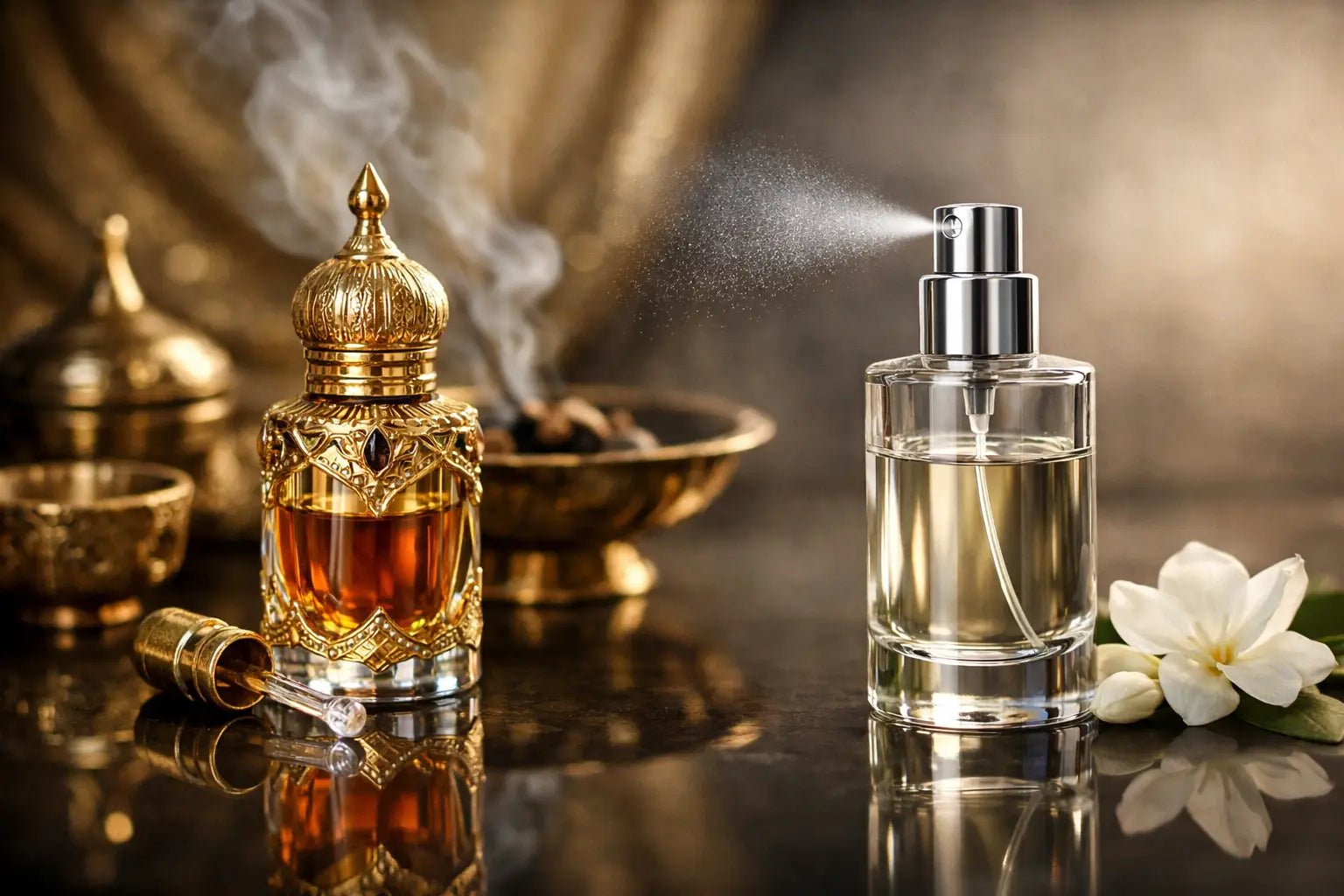
You smell a rich oud, a smooth vanilla amber, or a clean musk from an Arabic fragrance house and the first question usually is not just which scent to buy. It is arabian perfume oil vs spray - which format actually gives you the better wear, better value, and better experience for how you use fragrance every day?
That question matters more than most shoppers think. Two versions of a similar scent profile can feel completely different on skin depending on whether you buy it as a concentrated oil or a spray perfume. One may stay close and luxurious for hours. The other may fill a room faster and feel easier to wear on the go. Neither is automatically better. The right choice depends on how you want your fragrance to perform.
Arabian perfume oil vs spray: the real difference
At the most basic level, perfume oil is a concentrated fragrance in an oil base, while spray perfume uses alcohol to disperse scent into the air and across the skin. That changes almost everything about how the fragrance opens, projects, and lasts.
Arabian perfume oils often feel richer and more intimate. They sit closer to the skin, develop gradually, and can give you that smooth, expensive scent bubble people notice when they get near you. Spray perfumes usually make a faster impression. They project more strongly at first, feel more familiar to most US shoppers, and are often easier to apply quickly before work, dinner, or a night out.
This is why the comparison is not simply about strength. It is about scent behavior. If you expect an oil to perform like a high-projecting spray, you may be disappointed. If you expect a spray to give you the same soft, skin-melting depth as an oil, you may miss what makes oils special.
How perfume oil wears on skin
Perfume oils are popular in Arabian perfumery for good reason. They tend to emphasize depth, warmth, and texture. Notes like amber, musk, sandalwood, rose, saffron, and oud can feel especially smooth in oil form.
Because there is no alcohol burst, the opening is usually less sharp. You do not get that instant cloud in the same way. Instead, the scent unfolds closer to the body. For many people, that feels more refined. It can also make oils ideal for settings where you want fragrance to last without dominating the room.
Longevity is one of the biggest reasons people choose oil. A good Arabian perfume oil can stay on skin for many hours, sometimes even longer than a spray version. But there is a trade-off. Strong longevity does not always mean big projection. An oil may still be very much present on your skin while being less noticeable from several feet away.
Skin type matters here too. Oils often perform especially well on dry skin because they add an emollient base instead of evaporating quickly. If standard perfumes seem to disappear on you fast, oil can be a smart move.
How spray perfumes perform
Spray perfumes are usually the easier entry point for most fragrance shoppers. They are familiar, convenient, and designed to diffuse scent more broadly. That makes them a strong choice if you like noticeable projection, faster application, and a more immediate scent experience.
In many Arabian spray perfumes, the opening feels brighter and louder. Citrus, spice, fruity notes, and aromatic accords can come across with more lift at first spray. That initial impact is part of the appeal, especially for people who want compliments or want their fragrance to announce itself more clearly.
Sprays also tend to be more versatile for clothing. Many people prefer applying spray fragrance to both skin and fabric for extra performance. That can extend wear and create a fuller scent trail. With oil, application is usually more targeted.
The trade-off is that alcohol-based sprays can feel more volatile. Some open beautifully but lose their top notes faster. Others may project strongly early on and then settle down more quickly than expected. Performance depends heavily on concentration, formula, and brand quality, not just the fact that it is a spray.
Which lasts longer: arabian perfume oil vs spray?
If you are focused only on wear time, perfume oil often has the edge on skin. Its concentrated format and slower evaporation can help it stay present longer, especially in warm, resinous, or musky scent families.
If you care more about how far the scent travels, spray often wins in the early hours. It radiates faster and can create stronger projection, especially right after application. So the better question is not just which lasts longer. It is whether you want longer skin presence or stronger room-filling effect.
For example, if you want a scent for close contact, office wear, prayer, travel, or a personal luxury experience, oil may feel like the better investment. If you want date-night projection, event wear, or a fragrance that announces itself right away, a spray may fit better.
Value for money and buying confidence
Shoppers comparing Arabic fragrances usually care about value, and they should. One reason Arabian perfumery has built such a strong following in the US is that it often delivers premium scent profiles without designer markup.
When deciding between oil and spray, value is not just about bottle size. Oils are concentrated, so a small amount can go a long way. You may use less per wear, especially if the formula is potent. Sprays, on the other hand, often feel more convenient and flexible, which means some buyers get more practical use out of them even if they go through the bottle faster.
There is also a comfort factor. Many newer shoppers feel more confident with sprays because they understand how to wear them. Oils can feel more niche at first. But once people try a quality Arabian oil, especially in musk, amber, oud, or gourmand profiles, they often realize how luxurious and long-lasting the format can be.
That is why authenticity matters. Whether you buy oil or spray, performance depends heavily on getting the original product from a trusted source. A great formula in the wrong hands can turn into a disappointing purchase fast.
Who should choose perfume oil?
Perfume oil makes the most sense if you want a fragrance that feels personal, smooth, and long-wearing. It is a strong fit for people who like musks, ouds, resins, rose, vanilla, and warm skin scents. It also works well if you are sensitive to alcohol-heavy openings or just want something that feels a little more elevated and less mainstream.
Oil is especially good for layering too. You can wear it alone for a quieter scent experience or pair it with a matching spray to boost both longevity and dimension. This is a smart move if you love a scent profile and want it to perform from day to night.
Who should choose spray?
Spray is the better pick if convenience is a priority and you want stronger first impression performance. It suits shoppers who rotate fragrances often, apply on the way out the door, or want a scent people notice without needing close contact.
It is also usually the easier format for beginners exploring Arabic fragrances for the first time. If you are trying viral scent profiles from houses like Lattafa, Afnan, Armaf, Rasasi, Maison Alhambra, or Paris Corner, spray bottles often offer the most familiar experience with the biggest crowd appeal.
The smartest answer for many shoppers
For a lot of fragrance lovers, the best answer to arabian perfume oil vs spray is not one or the other. It is both, used differently.
Oil can be your base for longevity and intimacy. Spray can be your top layer for projection and convenience. That combination gives you more control over how a scent wears through the day. It also lets you adapt based on season, setting, and mood. In colder weather, rich oils can feel especially addictive. In social settings, sprays can make more impact faster.
If you are building a fragrance wardrobe instead of buying just one bottle, this is usually the better strategy. It gives you options without forcing every scent to do the same job.
At Ezenzia, that is exactly how many shoppers approach Arabic fragrance - not as a one-format category, but as a way to get more performance, more character, and more value from every scent they wear.
The best format is the one that matches your routine, your budget, and how you want to be remembered after you leave the room.


